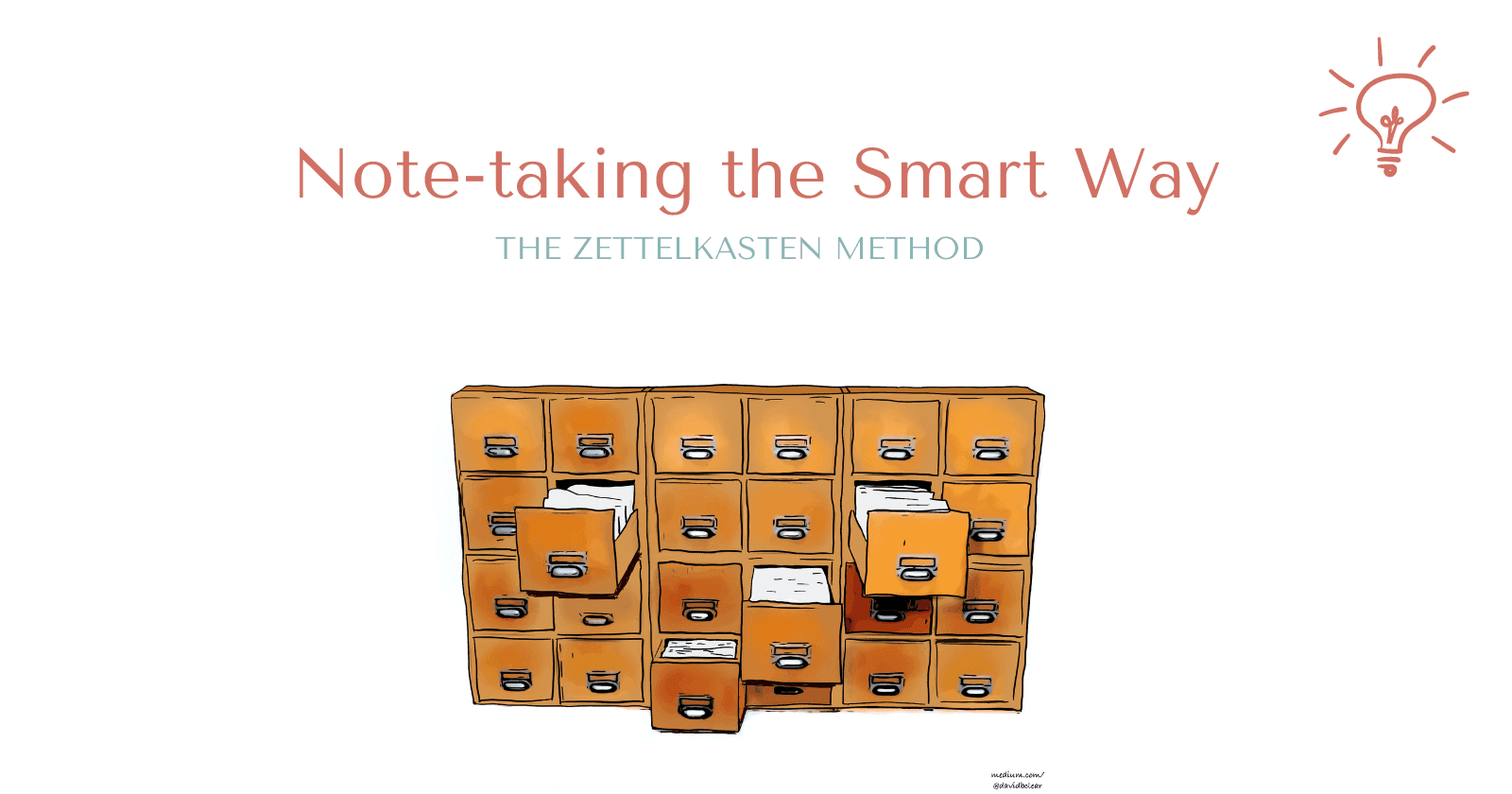
What is Zettelkasten?
Propagated by Niklas Luhmann, Zettelkasten is a powerful method of knowledge management to link your ideas together and put them to use. With this system, he was able to write over 400 research papers and 70 books in his lifetime. Take a moment for that to sink in. Four hundred research papers. 70 books. That is absolutely insane.
Furthermore, his system was nothing complex. Luhmann would write each note —whether his own idea or something he read — on one side of a flashcard. On the other side, he would write references to other past flashcards it referred to. When he need to write a paper on a particular topic, he would find a flashcard on it and then follow the links. Within no time, he would have enough material for the paper, and then it was a matter of just writing them together.
How do you apply Zettlekasten today?
The core concept is highly pertinent today, and, fortunately, we do not have to rely on just flashcards. Theoretically, all you do is simply take a new note and add links from it to related topics and other notes.
However, the big problem here is remembering those notes takes tremendous energy. Despite the initial complexity of the method, the end result can be incredibly rewarding, akin to a masterpiece of knowledge construction. There is no doubt the system is highly needed. Not just for academics, but for anyone alive today. After all, it is the era of the knowledge workers. The question is do we have the technology to apply this system without much effort on our parts? Can we take advantage of the end result by letting tech do the work of organizing our notes?
Applying Zettlekasten by letting AI do the work
The points in the system that require effort are:
-
Writing a note such that it can be retrieved easily
-
Finding notes and topics the note is related to
-
When we need to use our notes, looking up all the related notes
These points would end up taking hours if we were to do them manually. Fortuantely, we have the help of AI.
Automatically using Zettlekasten with this tool
What if there was a tool that existed that could do all these 3 and all you had to do was type and press enter? Well, Constella is here for exactly that. All you have to do is type your note and press enter to add it to your graph.
Next time you take a new note, old notes of the past will automatically appear. Here, the magic is you can drag and drop to create connections, just like a real graph.
And when you need to write an academic paper, make a business decision, or just do some thinking, you can just type what you want, and the related notes will appear.
Imagine having a tool like Constella at your fingertips, where you can effortlessly organize your notes and ideas with just a few keystrokes. With Constella, all you need to do is type your note and hit enter to seamlessly add it to your graph. As you continue to add new notes, the tool automatically displays related past notes, making it a breeze to connect ideas. This feature allows you to easily drag and drop to create connections, mimicking the fluidity of a real graph. Whether you're working on an academic paper, making a crucial business decision, or simply brainstorming, Constella streamlines the process by displaying relevant notes as you type. This innovative tool revolutionizes the way we organize and access information, making it a valuable asset for anyone looking to enhance their productivity and creativity.
Benefits of using the Zettlekasten system
**Enhanced Knowledge Retention ** The Zettelkasten system promotes active engagement with your notes. By linking ideas together, you reinforce your understanding and memory of the material. This interconnected web of information ensures that knowledge is not just stored but also deeply ingrained.
Improved Idea Generation By creating a network of related notes, the Zettelkasten system fosters creativity. When you review your notes, you can easily see connections between different concepts, sparking new ideas and insights. This method is particularly useful for writers, researchers, and anyone involved in creative work.
Efficient Information Retrieval One of the key advantages of the Zettelkasten method is the ease of retrieving information. Each note is linked to related notes, making it simple to follow a trail of ideas. This reduces the time spent searching for information and allows you to focus on your work.
Scalability and Flexibility The Zettelkasten system is highly scalable, allowing you to manage a large volume of notes without feeling overwhelmed. Whether you have a few dozen notes or thousands, the system adapts to your needs. Additionally, it is flexible enough to accommodate different types of content, from text and images to links and references.
The Best Zettelkasten Apps for 2024
Obsidian Zettelkasten
Obsidian is a powerful note-taking app that excels in implementing the Zettelkasten method. While Obsidian has a graph view, it requires a lot of manual tagging yourself to create that graph. While it is a great foundational tool, it has much missing in its automation and ends up becoming not much different from Apple Notes.
Notion
Notion is a versatile app that can be customized to fit the Zettelkasten system. Its great for taking documents for organizations and while the system can implement this method, it requires a lot of manual work: the same as searching through a file cabinet and looking up the right documents each time. This is not much different from the physical system and a lot of time will go away in this note taking system.
Constella
Constella is designed with Zettelkasten as one of its core principles and with the concept of having an assistant handle as many things as possible for you. It automatically retrieves similar notes as you type and search. It allows you to create connections with a simple drag and drop to create an automated note taking system where you can put your knowledge to work. With the chat feature, you can then simply tell your personal assistant to instantly create research papers without doing any additional work from the notes you had already been taking.
Conclusion
The Zettelkasten method, pioneered by Niklas Luhmann (though not called this at the time), has proven to be an invaluable system for knowledge management and idea generation. As we've explored, this method can significantly enhance knowledge retention, improve idea generation, and streamline information retrieval.
While traditional applications like Obsidian and Notion offer ways to implement Zettelkasten, they often require substantial manual effort. Enter Constella, a cutting-edge tool that automates much of the Zettelkasten process, allowing users to focus on thinking and creating rather than organizing. By leveraging AI technology, Constella represents the next evolution in note-taking and knowledge management. It not only simplifies the implementation of Zettelkasten but also amplifies its benefits, making it an indispensable tool for academics, professionals, and anyone seeking to optimize their intellectual output in our knowledge-driven era.
As we move forward, I am excited not only about how Constella is going to advance as we pour more time and effort into its research and development, but also how we as humans are going to become more and more intelligent thanks to our tools. The future may sometimes seem anxious and uncertain, but there's a lot to look forward to too.
Want more insights like this?
Subscribe to get short productivity tips and useful summaries of new tools every week.
Want more insights like this?
Subscribe to get short productivity tips and useful summaries of new tools every week.